
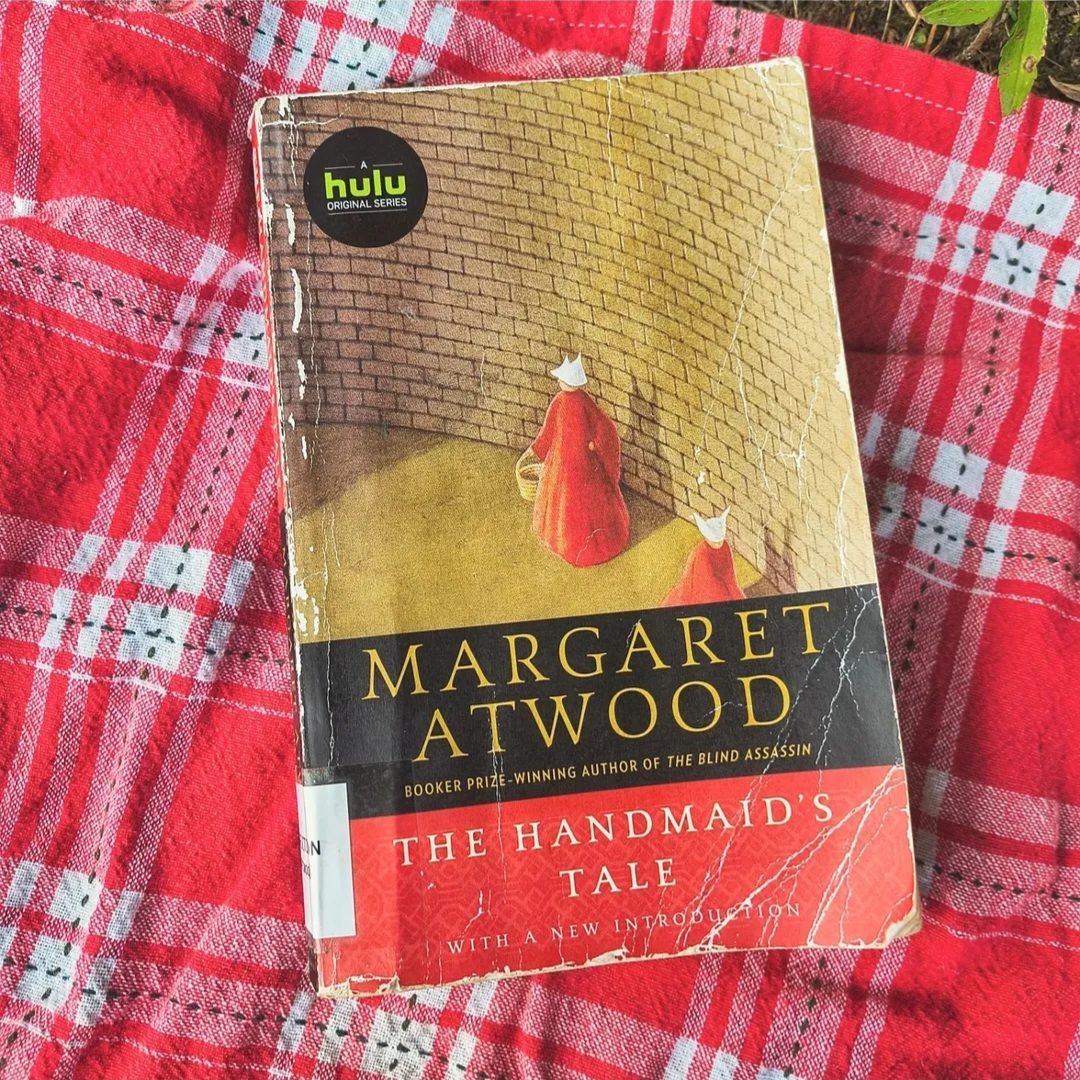
Title: The Handmaid’s Tale
Author: Margaret Atwood
Published: 1985
Genres: Speculative Fiction, Dystopian, Literary Fiction
Page Count: 320
Fable Rating: 4.1
My Rating: 5
Table of Contents
Summary
Offred is a Handmaid in the Republic of Gilead. She may leave the home of the Commander and his wife once a day to walk to food markets whose signs are now pictures instead of words because women are no longer allowed to read. She must lie on her back once a month and pray the Commander makes her pregnant, because in an age of declining births, Offred and the other Handmaids are only valued if their ovaries are viable. Offred can remember the years before, when she lived and made love with her husband, Luke; when she played with and protected her daughter; when she had a job, money of her own, and access to knowledge. But all of that is gone now…
funny unexpected, horrifying, and all together convincing, The Handmaid’s Tale is at once a scathing satire, dire warning, and tour de force
Quick Thoughts
***Trigger Warnings: Death, Forced Pregnancy, Hanging, Oppressive government, Prostitution, Rape, Sexism, Misogyny, family separation
While I will try to keep them minimal/vague, there will be mild spoilers in this review. Think in terms of general plot points and quotes.
This is my first time reading this book. After hearing its name many times in conversations and discussions about the current state of America, the world, and the political climate, it quickly made its way to my TBR. While exploring the tiny library near where I moved, this was the first book I saw on the shelves, and I figured now was as good a time as any to read it. I’m definitely glad I did. I rated this book 5 stars. Now lets get into why.
Characters
Offred-The Protagonist
The main protagonist and sole point of view in this story is Offred, a handmaid in Gilead. The book is told in a way that is her recounting not just the time before the republic but also her time during. We, the readers, are exactly that, readers. She recounts and tells us the story of her life as a Handmaid and her perspective on how everything changed. With Offred, we see the effects of this dystopian society clearly. Even her name is not her own, having had it stripped away and replaced with “Offred,” meaning of-Fred, an object of Fred. Her own name does not matter in a society where her womb is the only thing they see as valuable.
In most dystopian novels, the main character is a savior, a revolutionary. A person diving in to escape or even sometimes dismantle the system. Offred is not that. Her resistance is internal. She clings to memories of her life before. Her daughter, her husband Luke, her mom, college, her job, the simple freedoms she no longer has. Her acts of defiance are subtle. There is no revolt, guns blazing, taking down the government. Her acts of defiance are in remembering a song, intimacy, whispered words, staying alive, and butter.
Offred is the perfect example of a character that is relatable, maybe even to a fault. If we were faced with the same circumstances as everyday people, most of us would be like her. We would not be the heroes in every other book. Her character and point of view make the story more impactful for that reason. She is a keen, witty observer who has moments where you can see the teachings of Gilead working. You can see the effects of her being what I would say is brainwashed taking hold in some moments. We, as the readers, may get annoyed with that and root for her to get some sense, but her vulnerability shows just how horrifying this society is and how it would likely affect most people.
Fred-The Commander
Fred, or Offred’s Commander, is the tangible “bad guy” in this story. We hear about people being in charge, and carrying out rules and punishments in Gilead, but Fred, at least from the point of view we are reading, is the manifestation of the evil.
On one hand, he represents the patriarchal authority and the justification for Gilead’s existence. On the other hand, he is hypocrisy. He engages in forbidden things in a society he helped create. He banned rights and freedoms for millions so that he may contradict all of the “ideals” he publicly holds, all while having justifications for why everything is perfect as it is.
His interactions with our main character Offred show a disturbing sense of entitlement and need for control. He is a complex and the scariest type of villain in the way that he is just a man. He is educated, composed, seems to seek human connection, yet is one of the men who shaped this sick dystopian society to suit his needs and desires. He also, we can assume, is one of many who are bored and unfulfilled in the oppressive place they created. He illustrates how power can corrupt.
Serena Joy-The Wife
Serena Joy, The Commanders wife, is a complex character that has the reader feeling sympathy for her situation in all of this, but also extremely frustrated.
Before Gilead, she was a public figure advocating for the very “traditional values” that later stripped her of her own agency. In her pre-Gilead life, she is hinted at as being a vibrant, powerful woman. In Gilead, she is confined to a life with the “traditional values” she promoted, but also a life of bitterness and contempt. A life she, just as much as Offred, has no choice in.
Her relationship with Offred is one of resentment, jealousy, and a twisted shared oppression. She switches between coldness and vulnerability. She despises Offred for her fertility yet relies on her for a child. Her character shows that it isn’t some women who are the victims in this, it’s all, even if some can’t see it for themselves. She is a commentary on internalized misogyny and how oppressive systems can turn even the advocates into victims.
Moira-The Best Friend
Moira is Offred’s best friend before Gilead. She is quite a contrast to Offred’s internal rebellion and quiet endurance. She is what you would think a dystopian book main character would be like. Fiery and defiant she is overt rebellion. The incident at the red center and later at “Jezebel’s” showcases a different facet of resistance and adaptation.
Her presence both in Offred’s memory and in person serves as a beacon of hope and a reminder of life before. She refuses to be broken, maintaining her wit, sarcasm, and defiance, even in the face of oppression. While her choices in Jezebel’s seem saddening and maybe like she’s given up to the reader, it’s an act of survival. One on her own terms, where she retains a level of control the Handmaids are denied. We root for her to escape the way we do in all dystopian books, but she shows us the harsh reality of the oppressive society they are in. She is another example of doing what it takes to survive
Nick-The Chauffeur
**SPOILERS**
Nick, the Commander’s chauffeur, is an intriguing character in that we don’t know a lot about him, yet he is the catalyst. His true loyalties are kept ambiguous throughout most of the book. Is he an eye, keeping watch to report back to Gilead officials, a member of this secret rebel resistance, or simply just a person like Offred trying to navigate and survive in this dangerous world? His affair with Offred is one of the book’s most vital plot points. Offering her something forbidden, intimacy, comfort, and maybe even a genuine connection. His presence makes Offred comfortable. Maybe even too comfortable. We see her give up on working with people she knows help people escape, because she doesn’t want to lose this. The comfort and safety that Nick provides, even if she knows rationally it’s not sustainable.
Nick represents the gray areas, the unpredictable human element in a highly controlled system. He is a catalyst for Offred’s potential escape, but his motivations are kept unknown. Not just from Offred but from us as the reader. His character contributes to the sense of uncertainty and paranoia. He shows that trust is a luxury in Gilead, and even acts of kindness are shrouded in suspicion.
Aunt Lydia-The Face of Indoctrination
Aunt Lydia is one of the most terrifying characters in The Handmaid’s Tale. She is a woman who enforces the patriarchal system upon other women. As an instructor at the Red Center, she is responsible for the indoctrination and brutal training of the Handmaids. She embodies the “friendly” face of oppression, often using manipulative language and psychological tactics alongside physical punishment to break down the women’s will and force them into submission.
Aunt Lydia is the master of doublethink, presenting the women’s new role as one of sacred duty and protection, even though we can see it’s one of extreme dehumanization and sexual servitude that they have no choice in. Her character is interesting to me because she brings up the idea that women in the not-so-far past had it worse. After all, their actions caused them to be sexually assaulted, yet describe their duties as handmaids as something that protects them. They cannot be raped on the street, yet they also don’t have the free will to be on the street. This new society is better for women, and we can see how untrue and ironic that is, which makes it all that much more terrifying that a woman would believe these things enough to beat her ideals into others. She shows the terrifying reality of how women can be complicit in the oppression of other women.
The Setting
The story takes place in the Republic of Gilead, a totalitarian state established in what once was the United States, following a period of environmental collapse, plummeting birth rates, and a violent takeover. The narrative primarily unfolds in and around Cambridge, Massachusetts. The author’s choice for this is extremely effective in emphasizing the terrifying plausibility of this dystopia. It is not in a made-up world. It is in a historically significant city that is home to places like Harvard University. Which is later revealed to have become “The Wall,” a place for executions. The story is set in a near future. The year is unspecified, but the “old world” remnants, being things like video cassettes and old magazines alongside their new technology like surveillance systems, make a disturbingly close timeline.
The regime is built on a literal interpretation of the Old Testament, stripping woman of rights and categorizing them into rigid social classes based on their reproductive capabilities. Every aspect of life is governed by a strict religious ideal.
*Handmaids: Like Offred. Fertile women forced into sexual servitude to bear children for the ruling upper class, They wear red
*Wives: Wives of the Commanders. Infertile or past child bearing age. They wear blue
*Marthas: Domestic servants. They wear green
*Aunts: Indoctrinators and enforcers who train Handmaids. They wear brown
*Econowives: Wives of lower ranking men
*Unwomen: Those who are infertile, disobedient, or otherwise deemed unacceptable. They are sent to the colonies
Plot
The story begins with Offred living as a Handmaid in the house of Commander Fred and his Wife, Serena Joy. Her days are extremely structured and monitored. She is allowed out of the house only for specific errands, always accompanied by another Handmaid, and under strict rules. Her identity has been systematically erased. Her original name was replaced by a title that reflects her ownership by the household’s male head, the Commander. Her primary focus as a Handmaid is to participate in the monthly “ceremony”, a ritualized, emotionless act of sex with the Commander in the presence of Serena Joy, for the sole purpose of procreation.
Through Offred’s fragmented memories and flashbacks, we learn about the gradual dismantling of rights that led to Gilead’s rise. Women’s bank accounts frozen, women losing their jobs, families torn apart. We see the terrifying ease of how Gilead came to be. We learn of Offred’s loss of her Husband, Luke, and her daughter Hannah, whom she was forcibly separated from. We experience constant surveillance, the chilling rituals, and the profound loneliness of her existence.
Despite the overwhelming control, the human spirit finds quiet ways to resist. As Offred navigates her daily routines, she encounters subtle hints of a world beneath Gilead’s surface. There are forbidden connections, unspoken alliances, and desperate attempts to reclaim fragments of dignity and identity.
The plot then follows Offred’s journey as she explores these dangerous possibilities, always balancing the hope of connection with the ever-present threat of severe punishment. Offred must decide how far she is willing to go to survive, to remember, and perhaps to find a way out of her silent oppression
My Review
When it comes to classics, I have this idea in my mind that while I should read them, I don’t want to because they will probably be immensely boring. I think my idea of classics was that they are something that everyone should read and everyone will talk highly about, even if they are not actually enjoyable. This idea may come from the fact that I have read very few of them, but this book surpassed my expectations in the best way.
This book completely captured my attention, and I was fully engaged the entire time I was reading. The Introduction at the beginning of my copy is from Margaret Atwood in 2017. If you have already read this book, but maybe not that specific introduction, or are going to read it for the first time, I HIGHLY recommend reading this version of the book. This is one of the very few introductions I’ve read, and I’m glad I did. It added so much depth and information to the story that it really helped me enjoy it even more. It talks about her thought process while writing this dystopian novel:
“I’d read extensively in science fiction, speculative fiction, utopias, and dystopias ever since my high school years in the late 1950s, but I’d never written such a book. Was I up to it? The form was strewn with pitfalls, among them a tendency to sermonize, a veering into allegory, and a lack of plausibility. If I was to create an imaginary garden, I wanted the toads in it to be real. One of my rules is that I would not put any events into the book that had not already happened in what James Joyce called the “nightmare” of history, nor any technology not already available. No imaginary gizmos, no imaginary laws, no imaginary atrocities. God is in the details, they say. So is the devil.”
I think part of the reason this book was so captivating to me has to do with that quote. I talked about this a little bit in the character description of Offred, but this is not your usual dystopian novel. Like a lot of us would be in her situation, the main character is not the leader of a rebellion. She is not the person taking it down and freeing everyone. She is a normal person who is doing what it takes to survive in an almost too close to reality dystopia. She is affected by the brainwashing and indoctrination, like a lot of us would be. It’s sad to say, but that’s why those practices were created; they work. The part of the quote where she says her rule was to not include anything that didn’t already happen in history adds a scary depth to the book that I wouldn’t have gotten without reading this introduction.
Another thing the introduction adds is answers to questions she says she is asked most frequently which I think are important to include. Questions like “Is The Handmaid’s Tale a “feminist” novel?”
“If you mean an ideological tract in which all women are angels and/or so victimized they are incapable of moral choice, no. If you mean a novel in which women are human beings-with all the variety of character and behavior that implies-and are also interesting and important, and what happens to them is crucial to the theme structure, and plot of the book, then yes.”…
“Is The Handmaid’s Tale anti-religion?”
“Again, it depends on what you may mean by that. True, a group of authoritarian men seize control and attempt to restore an extreme version of the patriarchy, in which women (like nineteenth-century American slaves) are forbidden to read. Further, they can’t control money or have jobs outside the home, unlike some women in the bible. The regime uses biblical symbols, as any authoritarian regime taking over America doubtless would: they wouldn’t be Communists or Muslims.” …..”Offred herself has a private version of the Lord’s Prayer and refuses to believe that this regime has been mandated by a just and merciful God. In the real world today, some religious groups are leading movements for the protection of vulnerable groups, including women. So the book is not “anti-religion.” It is against the use of religion as a front for tyranny; which is a different thing altogether.”
“Is The Handmaid’s Tale a prediction?”
“That is the third question I’m asked-increasingly, as forces within American society seize power and enact decrees that embody what they were saying they wanted to do, even back in 1984 when I was writing the novel. No, it isn’t a prediction, because predicting the future isn’t really possible: there are too many variables and possiblities. Let’s say it’s an anti-prediction: if this future can be described in detail, maybe it won’t happen. But such wishful thinking cannot be depended on either.”
I can see why this book is one of the most banned, which is extremely ironic in a predictable way. She says it is not anti-religion, yet a lot of us know that some people will see it that way, no matter what, because the fictional Republic of Gilead bases its ideals on the Old Testament. The point to me is that it truly is not about religion at all, but that they used it as a guise to oppress millions. Taking this book as an offense to your beliefs says a lot to me. There are so many things I could quote and discuss from this introduction in great detail, but I fear I must move on if I ever want to finish this post. It truly is such an interesting read that really gets you thinking not just about the story but also our current situation in America.
I rated this book 5 stars not just because of its importance concerning today’s world, but also because it was wonderfully written, a twist on the dystopian genre that I loved, and just genuinely a great book.
The characters feel real, as does the world Margaret Atwood created. It shows how quickly things can change before you realize it and the effects it would have on real people. The switch to understanding that Offred is retelling this story and it is not currently happening to her was perfect. Seeing her internally grappling with the crazy, evil world she is in, and being stuck between silent rebellion and trying to conform, was a really captivating point of view. The sad reality is, most people wouldn’t make it out of something like this. We see multiple characters in this book take their ending into their own hands in whatever way they see fit. Whether that be in the way Moira did it or the Handmaid who lived in the room before Offred.
The parts where it really makes you think of the real-life history of feminism, like the scene where Offred can remember magazines being burned by her mother and friends because they didn’t agree with the women on the cover being nude, I feel, are definitely relevant today. The blame then was on the women in the magazines, while also saying their purpose of burning them was to benefit women. The Aunts at the Red Center have the same style of thinking; they are saying that the Handmaids are being saved and protected, while also indoctrinating them into this society. It is a genius parallel. As I said before, they say they are “protected” from the dangers women used to face only if they conform. There is a part in the book when a character at the Red Center is shamed for being sexually assaulted as a teenager. The aunts have the others chant at her that she was leading them on and it was her fault. This, to me, proves the twisted logic they used to get these women to conform. They are protected, but it is also the woman’s fault, not the man who committed the atrocity. The scene where Offred sees tourists wearing shorts and is shocked by how naked they look is a direct reaction to having lived in a society with so much stripped away. I can think of many recent real-life events on social media where women are attacked by other women for deciding how they want to use their autonomy. My mind has been brought back to this book a lot in those moments.
The Commander character is perfectly evil. Him helping to create this society while also saying things like quote “Everyone’s human, after all.”….” It means you can’t cheat Nature, … Nature demands variety, for men. It stands to reason, it’s part of the procreational strategy. It’s Nature’s plan.” and his relationship with Offred proves it was not about them believing the way the world was before was wrong. Just that it was wrong that the woman had the choice. Things like clothes that aren’t the assigned full coverage gowns and headdresses, reading, songs, alcohol, and makeup are all things they deemed unacceptable for women to have, yet a place like Jezabels exists. It’s not about morals, it’s about control.
The ending was absolutely genius, and I felt it ended perfectly.
Overall, I could still say so much about this book, but I’m so glad I read it. It truly deserved 5 stars from me, and it’s a book I will be thinking about for a long time.
Links
Barnes and Nobel:
https://www.barnesandnoble.com/w/the-handmaids-tale-margaret-atwood/1100295471?ean=9780385490818
Fable:
https://fable.co/book/the-handmaids-tale-by-margaret-atwood-9780547345666


Leave a Reply